Pressings
Every coloured record is a one-off
In 2025 a Polish fan club pressed 150 copies of Riverside's Live Acoustic on blue splatter vinyl. At least one copy came out wrong. Its labels and sleeve say Riverside, but its grooves play Miles Davis's Kind Of Blue. On Discogs, one person owns it and 75 want it.

Forty seconds a record, or an hour for 25
PVC pellets melt in an extruder into a hot 170-gram puck, and the press squeezes it flat between two stampers. At Gotta Groove in Cleveland, Heath Gmucs says, that makes a 12-inch record in under 40 seconds. Gmucs also makes one-off pressings as Wax Mage, and there he spends up to an hour on 25. "I sort of feel like a chef over here, cooking up vinyl," he told WKSU in 2019.
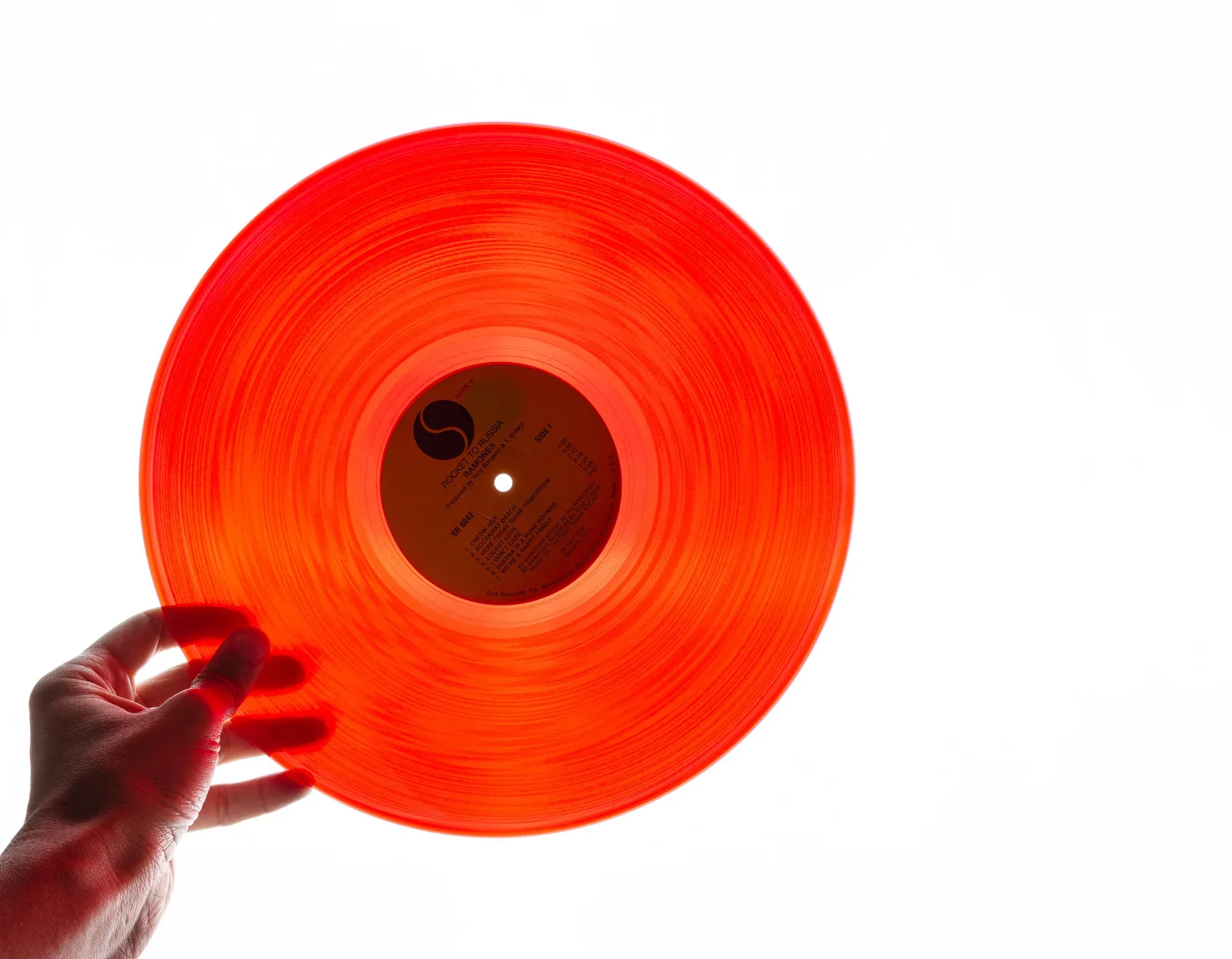
Each PVC colour melts at its own temperature, so the press is set again for each one. PVC with nothing added comes out hazy white, so clear vinyl is tinted too.
Plain colours run on automatic presses. At Gotta Groove, splits, splatters, stripes and pinwheels skip the extruder. Someone places the vinyl into the mould by hand, for an extra $9 to $25 or more per record. Erika Records makes splatter by scattering fragments of coloured vinyl over a base. Furnace sells it light, medium or heavy, and compares the choice to the cheese on a pizza. It presses its effects only at 140 grams.
A half-and-half record needs two extruders, one per colour, feeding a mould split by a thin metal wall, which keeps the seam sharp. Ben Blackwell, who ran vinyl at Third Man Records, described the process in 2010. Third Man's first three-colour singles were cut and reassembled by hand. "Someone has to press a button for every record pressed," he said. There were 100, sold only at the Nashville store, and fans queued overnight.
Between jobs, the extruder is purged, and the first records of a new colour can carry a trace of the last one. Gotta Groove warns that small black flecks show most in white and clear.
Your copy is not the photo
At Gotta Groove, a purple mix can come out plain red on some copies and plain blue on others. The same mix ordered twice can look different. Short runs swirl less, and a 7-inch swirls less than a 12-inch, because its puck is smaller. At Key Production, the darker centre of a colour-in-colour record may sit off-centre, or show on one side only.
Key Production's eco-mix is the day's leftover colours, different on every record. Program Records in Melbourne sorts its regrind into blue-ish, green-ish, red-ish and "lucky rainbow". Furnace offers Color Melt and Smoke, and Gotta Groove has nebulas and coin flips. The Czech giant GZ Media launched a spring 2026 collection with shades called Point Nemo and Snowpiercer.
The colour keeps changing after it leaves the plant. Charlie Horner, a record collector with a PhD in organic chemistry, explains that see-through coloured vinyl relies on light stabilisers that slowly run out. Then sunlight turns the record yellow, orange, brown and almost black. Opaque colours carry pigments that protect them. Some yellow copies of Grand Funk's We're an American Band now sell as "orange".
Colour was always about the look
In 1949 RCA colour-coded its new singles by genre. Its own promotional film lists ruby red for classics, yellow for children, green for country, cerise for rhythm and blues, and black for pop. Trouser Press predicted more coloured LPs in 1978 than in all earlier years combined. Record Store Day, from 2008, turned limited pressings into an annual queue.
Taylor Swift's four Midnights LPs had back covers that form a clock when hung together. In 2024 Billie Eilish called campaigns with dozens of variants wasteful. She admitted she does it too: Billboard counted eight variants of her Happier Than Ever, pressed from recycled vinyl.
Unique is not rare
Every splatter copy is unique, but that alone doesn't make it rare. Rarity comes from a small run, a number on the sleeve, or an accident.
Nirvana's Bleach has all three. Its 1989 first pressing was 1,000 white copies. A later run of 500 numbered copies came on red-and-white swirl. As the story goes, a later batch came out a colour nobody intended, and most of it may have been thrown away. Collectors call it the "iceberg" pressing, and one Nirvana discography values it at several times the white.
The Riverside record has two of the three: a run of 150, and the mistake that made one copy play Miles Davis. Test pressings sit outside the game. Disc Makers presses every one in black, even for a coloured release.
One album, a dozen colours
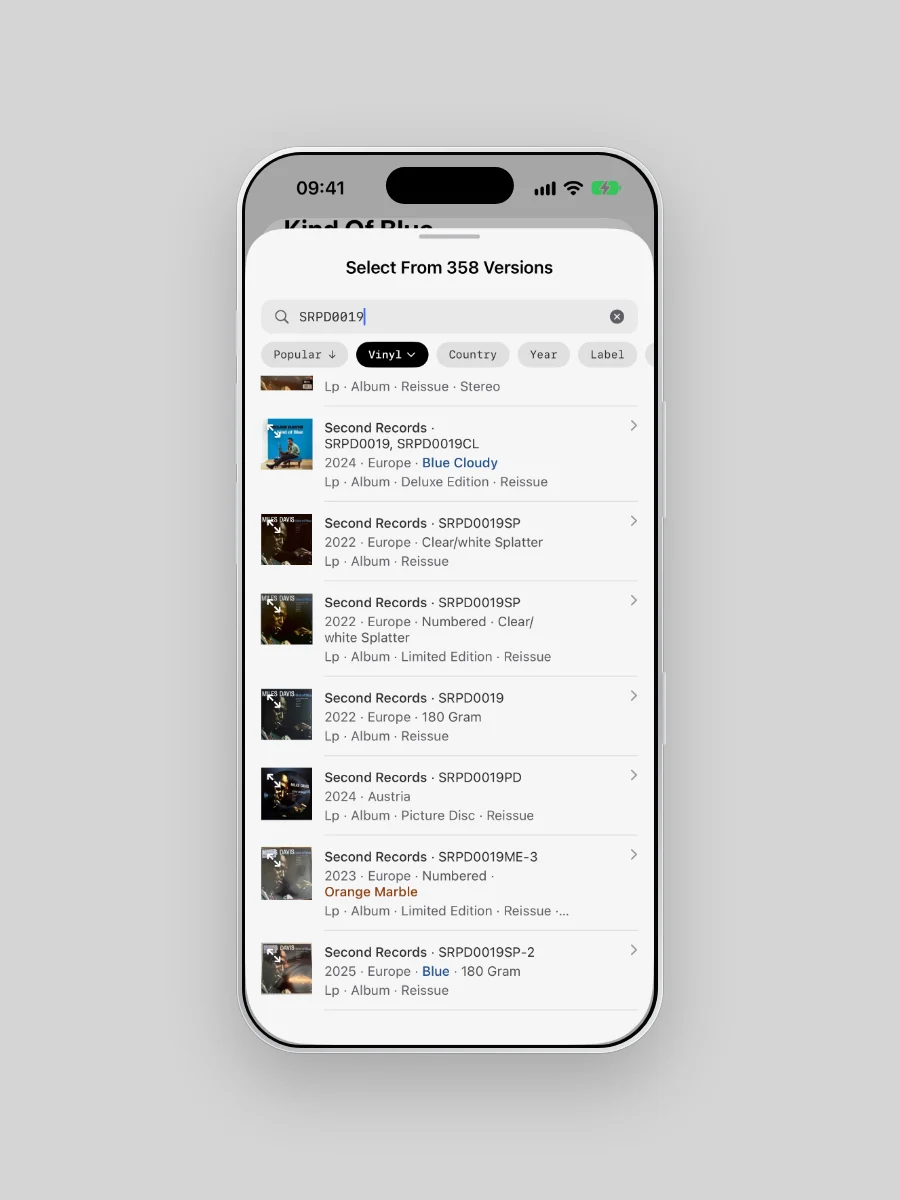
Kind Of Blue has 358 vinyl versions on Discogs. Up to 2009, most came from Columbia or labels it licensed. Since 2010, most come from Europe. The EU protected recordings for 50 years, and its 2011 extension to 70 years came too late for a 1959 album.
Many of those copies come from European labels such as Second Records, DOL and Wax Time. Comparing three copies of Monk's Brilliant Corners, critic Robert Baird found public-domain pressings like these cheaper and flat-sounding. These labels dress Kind Of Blue in blue marble, blue cloud, orange marble, yellow and crystal clear.
Licensed coloured copies are fewer. Columbia made an opaque blue for Target in 2023. Analogue Productions' 2025 edition is blue, numbered and limited to 1,500 copies. The label says Bernie Grundman mastered it from the original tapes.
How it sounds
Mostly like black, with more risk on effects. Steve Lynch of Program Records told What Hi-Fi that colours share black's sound, with subtle differences. "Black is always a safe bet!" he added. Disc-cutting engineer J.I. Agnew explains why you can hear splatter. The stylus crosses from one colour's particles into another's, and the background noise changes character as it goes. Loud rock hides it. Quiet jazz, like Kind Of Blue, does not.
"Weight alone doesn't determine audio quality, the mastering does," says the pressing plant Hellbender Vinyl. Labels put their most careful editions on 180 grams, like the Grundman Kind Of Blue, so heavy came to mean premium. Now 180 grams is standard at many plants.
Your copy, in your pocket
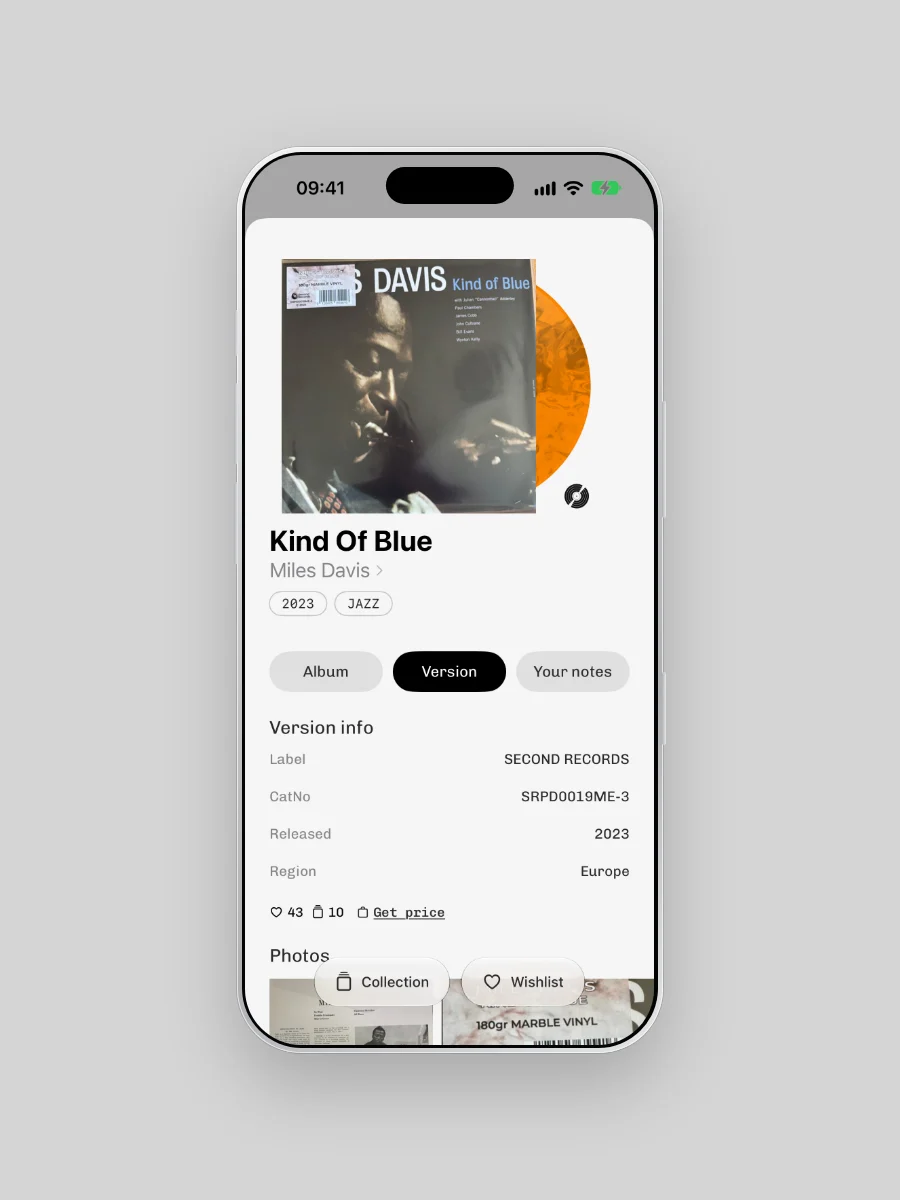
On Discogs, a pressing's colour is typed by whoever holds a copy. One 2024 Kind Of Blue is listed simply as "Lagoon". In Plastic, each record turns behind its sleeve in its listing's colours and main pattern, on iPhone and Android. If your copy came out differently, or has faded, change its colours to match.
Was yours the orange marble or the crystal clear? On iPhone, the version picker writes colours such as Blue and Orange Marble in their own colour. Those pressings stand out in a list of 358. Group them in a Collection, or show them on your public page.
- Scan the sleeve or its barcode.
- Pick your pressing.
- Watch the record turn in its colours.
- Not quite right? Change its colours.