Collecting
What is a discography? LP, EP and single explained
When you fall for an artist, one album is never enough. A discography lets you follow the whole story, from the first record to the last. Play it in order, the way you play an LP from the first track to the last. You hear the artist change, and sometimes a whole genre with them.
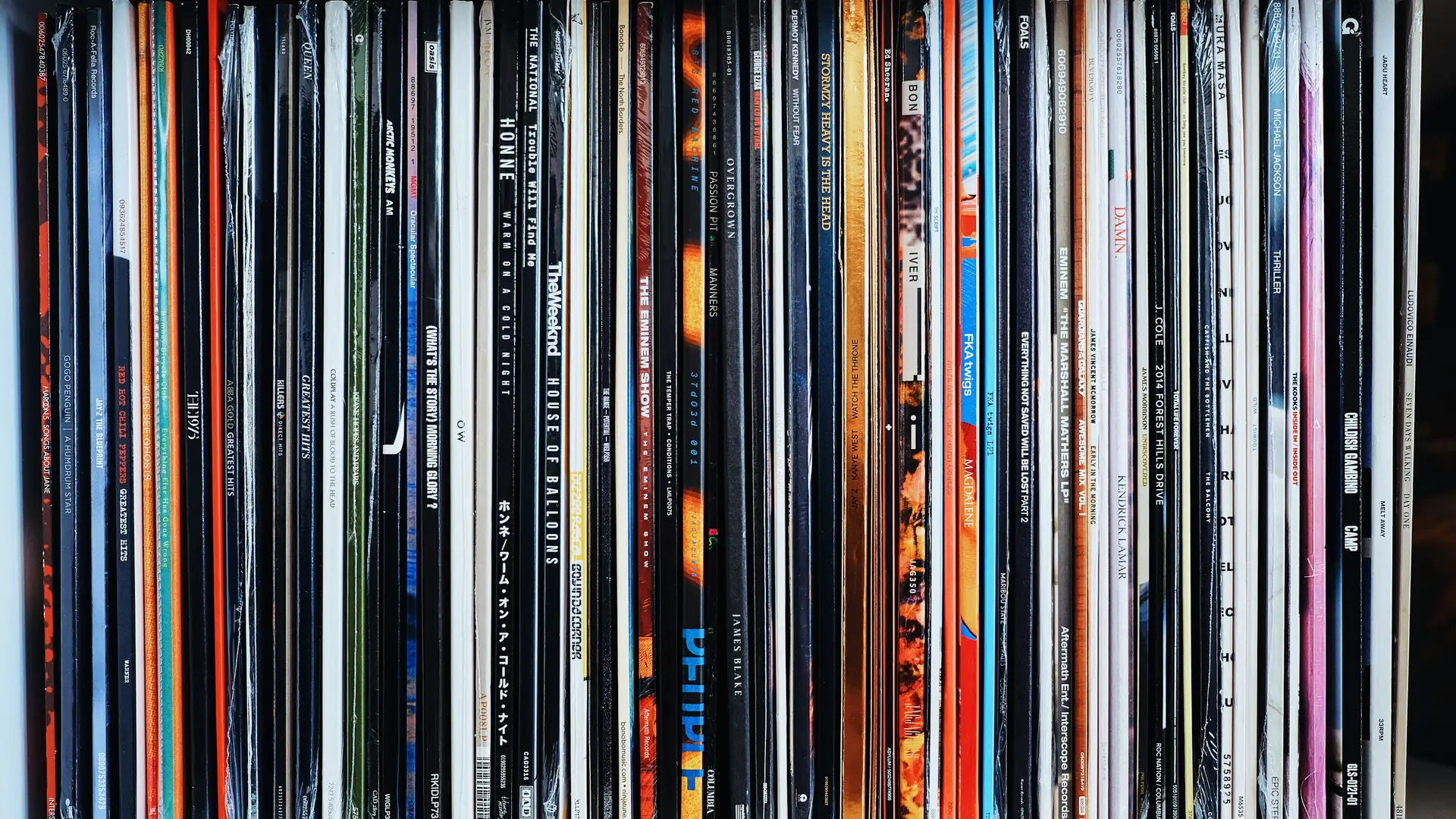
Albums are the backbone of a discography. Around them sit the singles and EPs, which often carry the songs of a future album. Fans who go deeper add live records, compilations and remixes.
The hard part is keeping track. What did the artist release? Which of those records do you own, and which do you still miss? It gets harder when the artist is new to you.
The record database Discogs has a page for every artist, and so do many collection apps. Open one for a big band, and you meet hundreds of entries with little structure. Connect your Discogs account to Plastic, our collection app, instead. You get the discography sorted by type, with your records marked.
What is a discography?
A discography is the full list of an artist's released recordings. It is grouped by type and usually sorted by year.
The word describes the music, not the objects. Abbey Road is one line in the Beatles' discography. It stays one line, however many times a label pressed it.
Most discographies split into the same few groups: albums, singles and EPs, live albums, and compilations. The record database MusicBrainz uses those types too. It adds labels such as soundtrack and remix on top.
What is the difference between an LP, an EP and a single?
All three names started as record formats. Today they describe length.
An LP is a full-length record. On vinyl, it is a 12-inch disc that turns at 33⅓ rpm.
A single carries one main song, the A-side, and often a second song on the B-side. A 7-inch single turns at 45 rpm. That is why collectors call a single "a 45".
An EP sits between the two: more songs than a single, fewer than an album. A mini-album is a near-synonym.
A double album is one album on two records. A box set packs several records, often several albums, into one release.
Where does an EP stop and an album start?
Nobody owns the line, so it moves with whoever counts.
- The Grammys call a recording an album at five tracks and 15 minutes. A recording of 30 minutes also counts, with any number of tracks.
- Streaming services label releases themselves. Distributor guides report the usual rule: one to three tracks is a single. Four to six tracks under 30 minutes is an EP. Seven tracks or more, or over 30 minutes, is an album.
The Beatles' Magical Mystery Tour shows the problem. In Britain it came out in December 1967 as two 7-inch records with six songs, about 19 minutes in all. By the streaming rule, that is an EP. By the Grammy rule, it is an album.
In the United States, Capitol added five songs from the year's singles and sold it as an 11-song LP. Same title, same year, two types.
Albums often form this way: the singles come first, and the album collects them later.

What counts as an album?
An album is any full-length release. The types below are all albums. A discography keeps them in separate groups because they answer different questions.
- Studio album. New music recorded for that release. When people say "their third album", they mean this.
- Live album. A concert recording.
- Compilation. Songs that were already out, collected again. A greatest hits record is a compilation.
- Soundtrack. Music from a film or a show.
- Unofficial release. A bootleg: a record the artist and label did not approve.
A reissue is not a type. It is a later pressing of an album that already has its line in the discography.
Why does one artist have hundreds of "albums"?
Because Discogs has no type for a studio album. It tags any full-length record as an album.
A concert record, a film soundtrack and an interview disc can all carry that tag. On an artist page they land in one list, beside Abbey Road and Revolver. Apps that read Discogs inherit the same list.
Pressings make it longer. A pressing is one manufactured version of an album: one label, one country, one year. On 10 November 2026, Discogs listed 1,129 pressings of Abbey Road alone. A list that does not fold them into one row counts the same album again and again.

How collection apps show a discography
Plastic is a collection app for vinyl, CDs and cassettes on iPhone and Android. It is our app, so read this part as a maker's view.
Most collection apps are built around a database, and your records are entries in it. Plastic is built around you as a collector: your shelf, your artists, your albums.
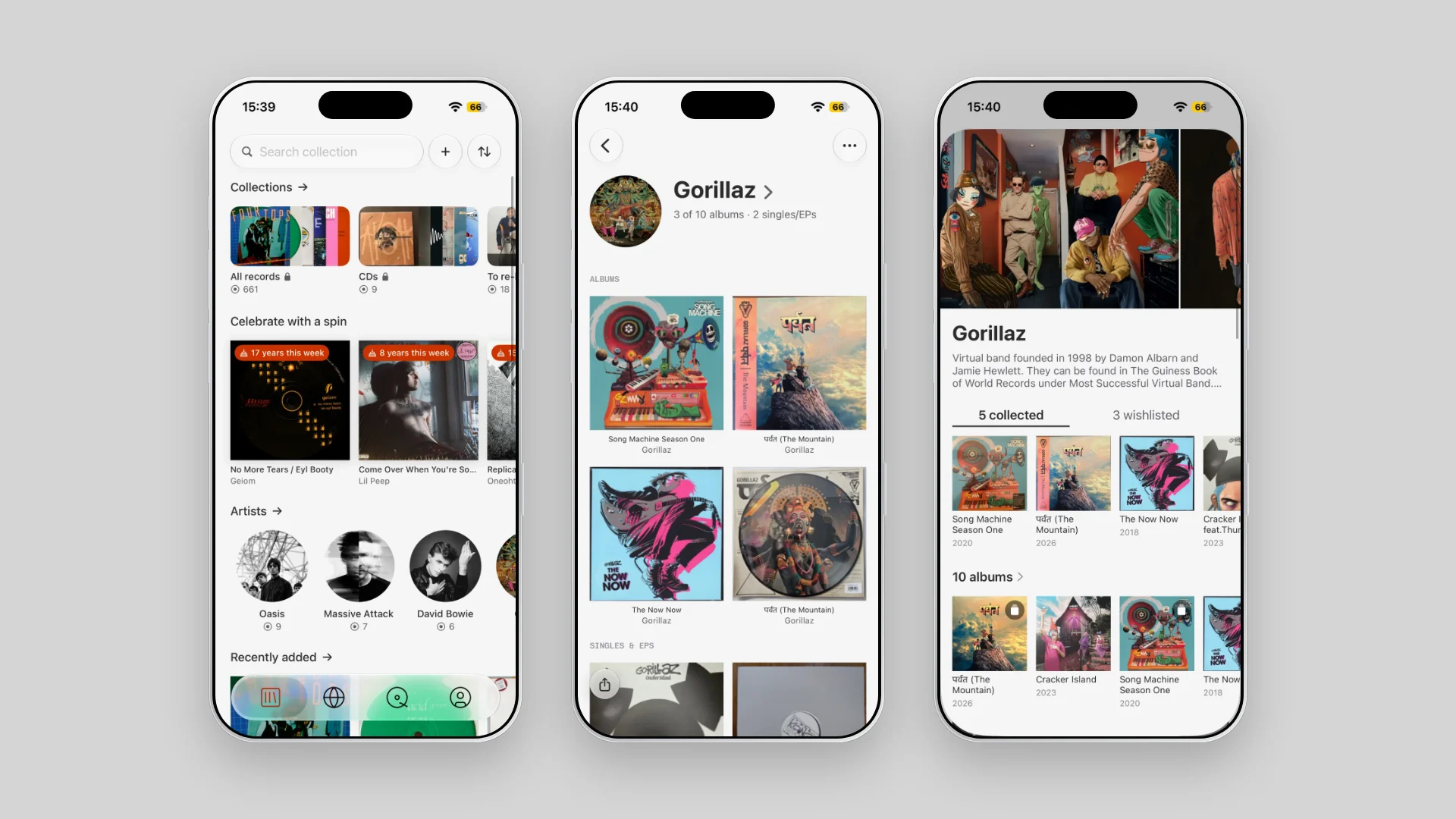
Each artist has a page, and each album has one row on it, however many pressings exist. Albums sit apart from singles and EPs, live records and compilations. A mark shows each album you own. The line under the band's name tells you how far you are: 3 of 10 albums for Gorillaz here.
Tap an album, and its pressings open in a separate list, where you choose the one you hold.
Now the other apps. We opened the Beatles in each one and counted.
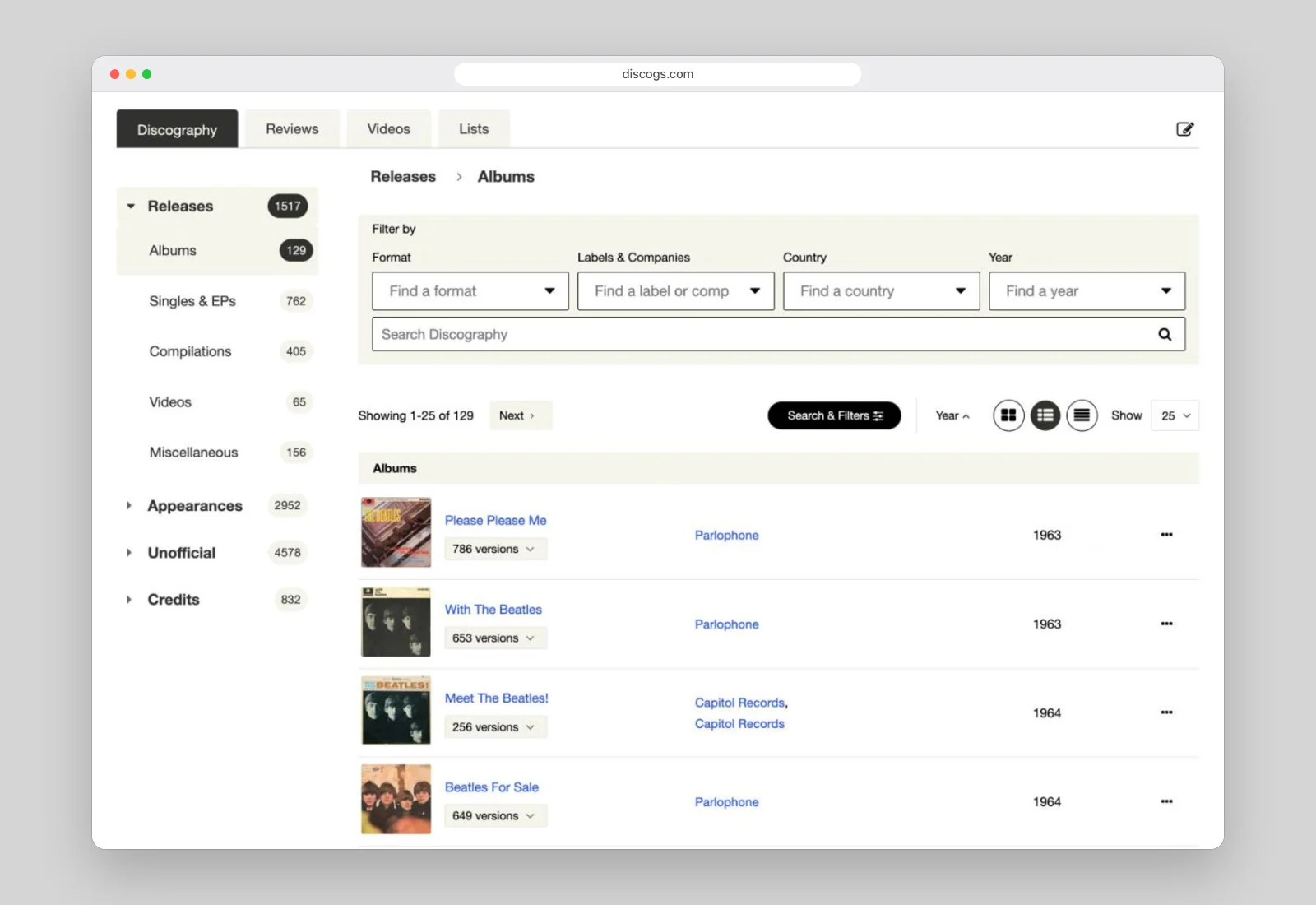
Discogs is the record database that several of these apps read. Its strength is the pressing: every pressing has its own page, with label, country and year. Its artist page has sections, but the Albums section is wide. On 10 November 2026 it held 129 albums for the Beatles, with 762 singles and EPs and 405 compilations beside it.
We tested the next two apps by hand in September 2026.
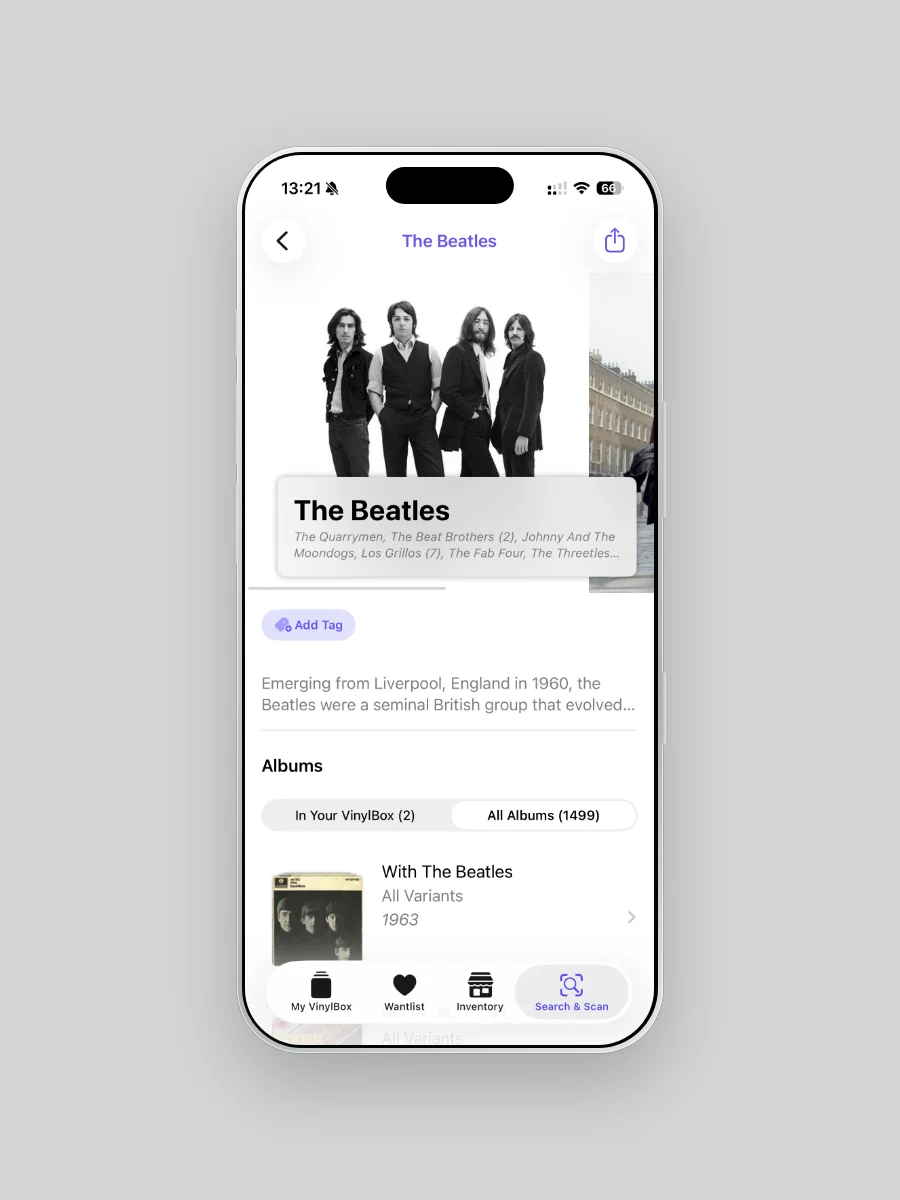
VinylBox has a switch between the albums you own and all albums. In our test, "All Albums" for the Beatles held 1,499 entries. Live tapes from Hamburg, an interview record and film soundtracks sat in the same list as the studio albums.
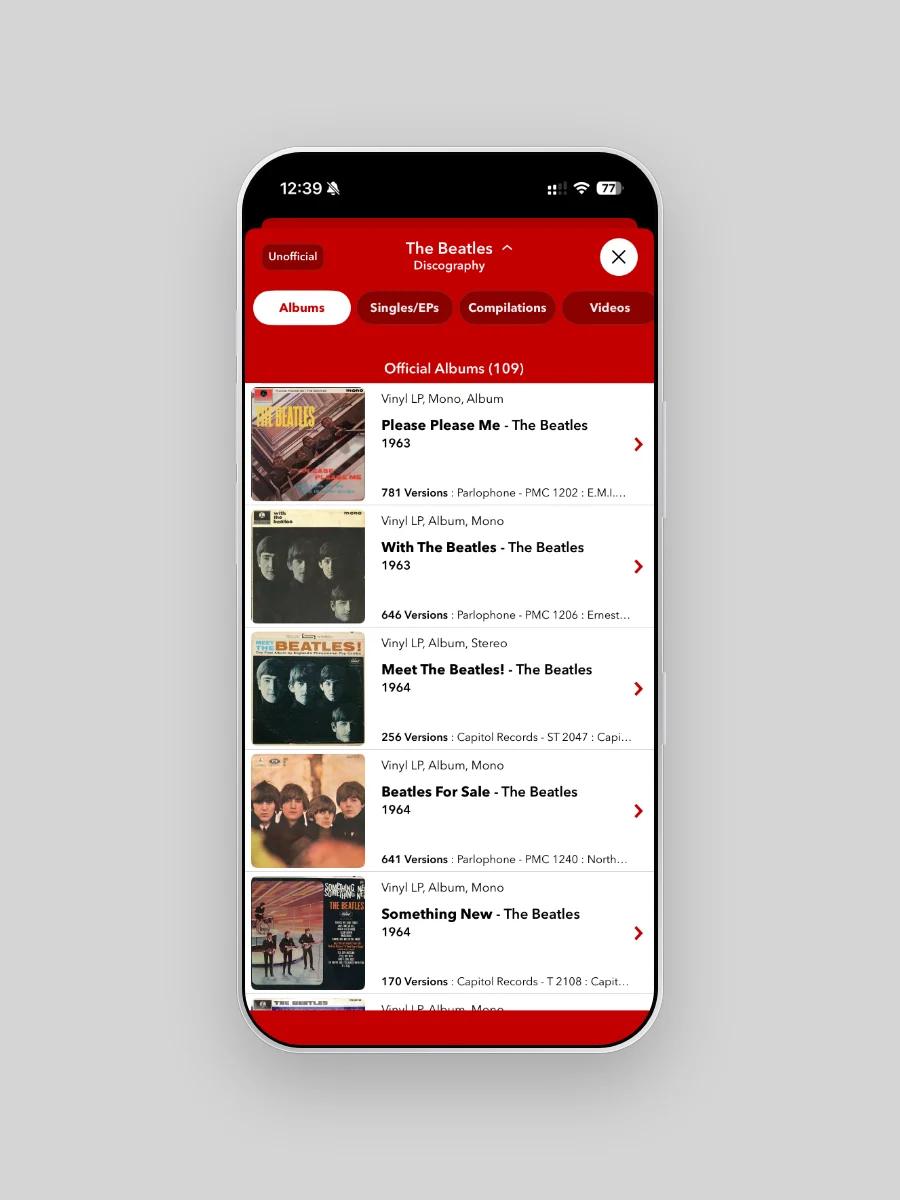
Discographic sorts by type: albums, singles and EPs, compilations and videos, with unofficial records behind their own button. It shows how many pressings each album has. It marks the records in your collection too. Its "Official Albums" list for the Beatles held 109 entries in our test. Promo records and digital files sat in it next to the studio albums.
CLZ Music is built for detail on the records you own, with custom fields and a folder for each artist. In the sources we read, we found no page for the albums you do not own yet.
The pattern is the same in all of them. The data is deep, and the Albums list runs far past the band's twelve studio albums. The reader has to do the sorting.
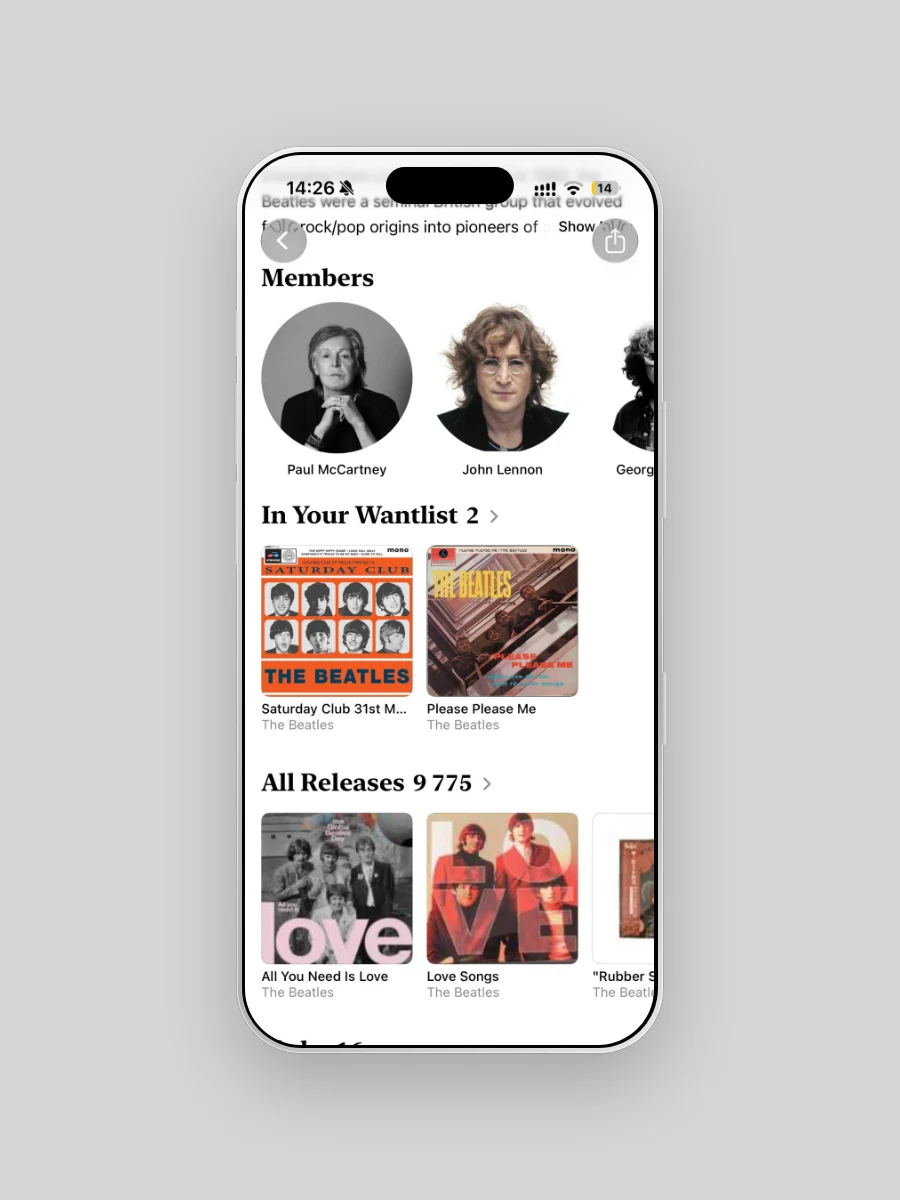
SnapVinyl works on top of a Discogs account. Its artist page shows the band members and the records on your wantlist. Then comes one row: "All Releases", with 9,775 entries for the Beatles in our test. Albums, singles and every pressing sit in that one row.
Groovv, Record Scanner, VinylSnap and MusicBuddy have no artist page. You can open a record, but you cannot see the artist's discography or check which of their albums you own.
Vinyl Record App has an artist page with one list, sorted by title. For the Beatles it opens with a radio record, an album sampler and an interview disc. Nothing separates the albums from the rest.
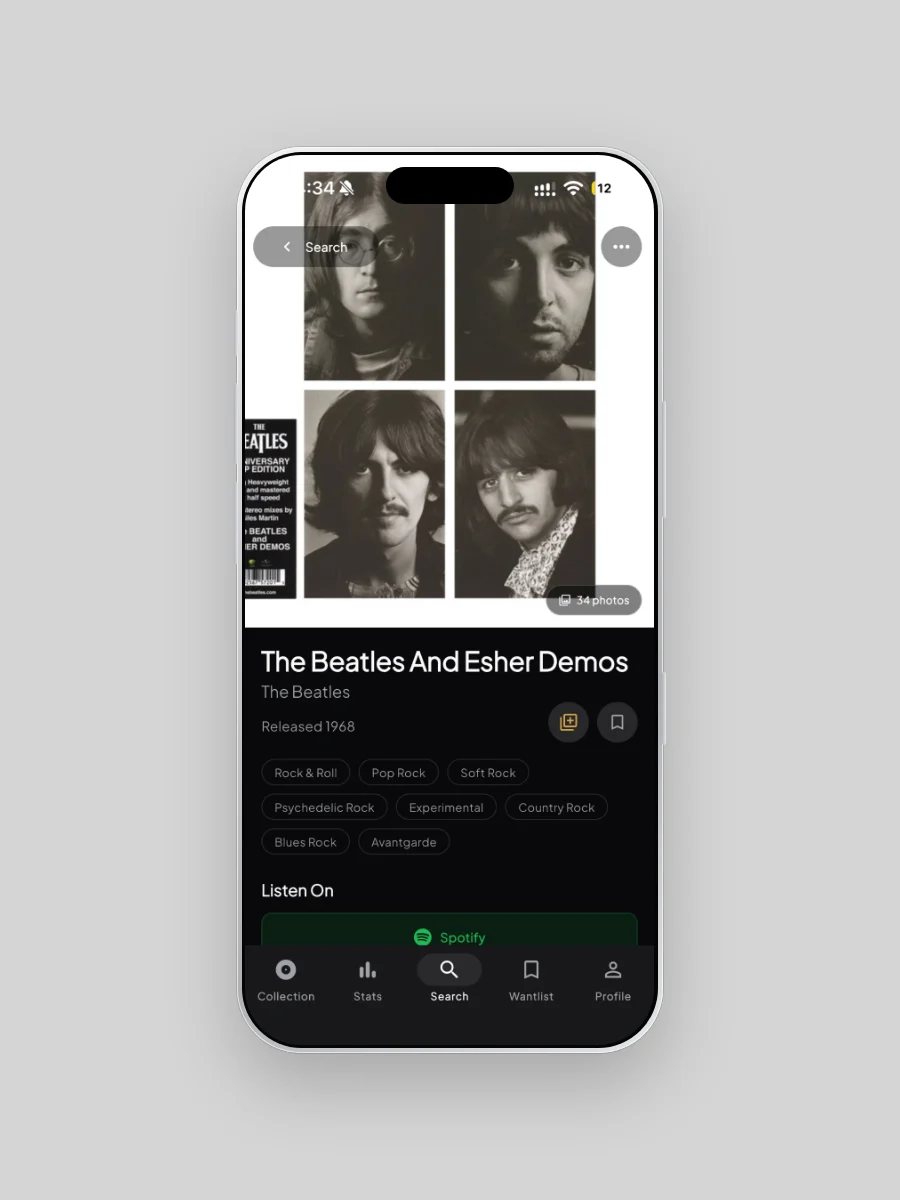
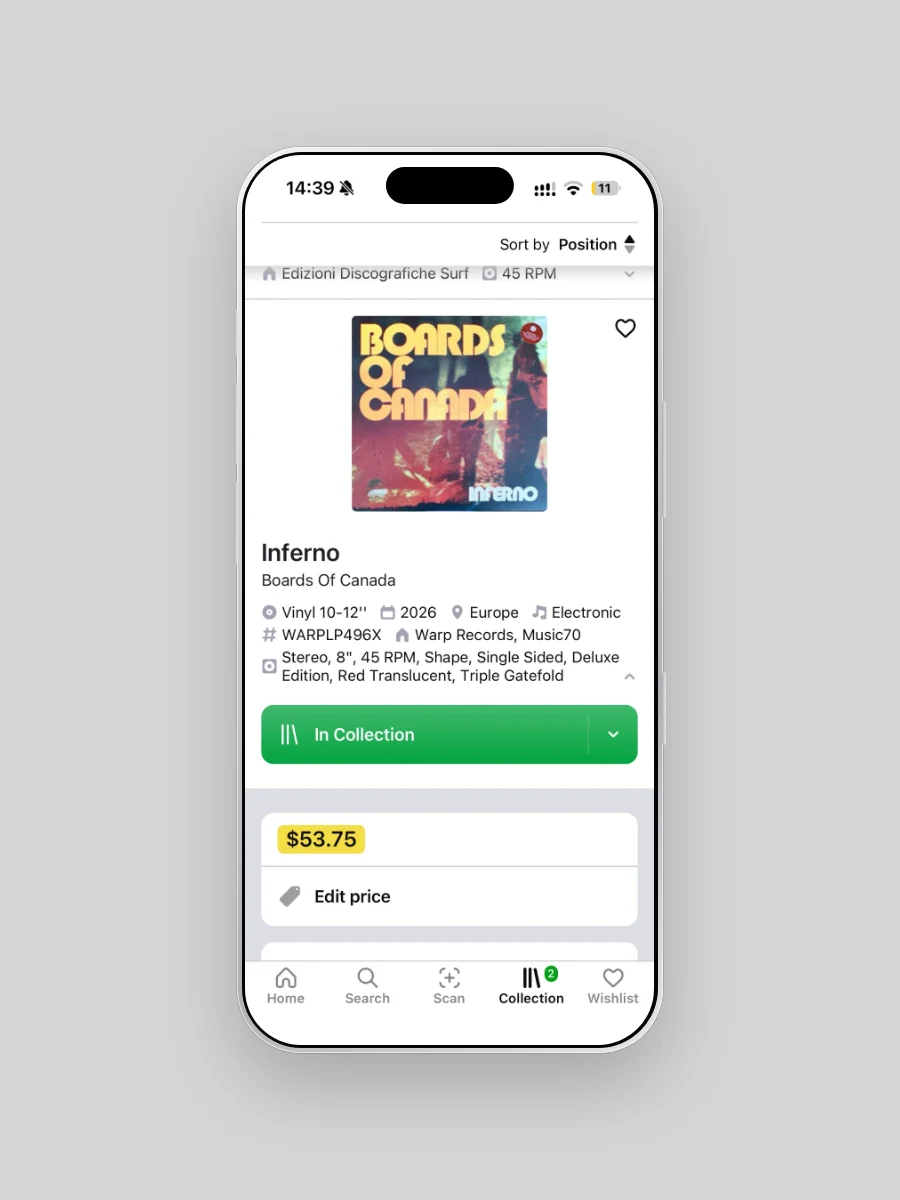
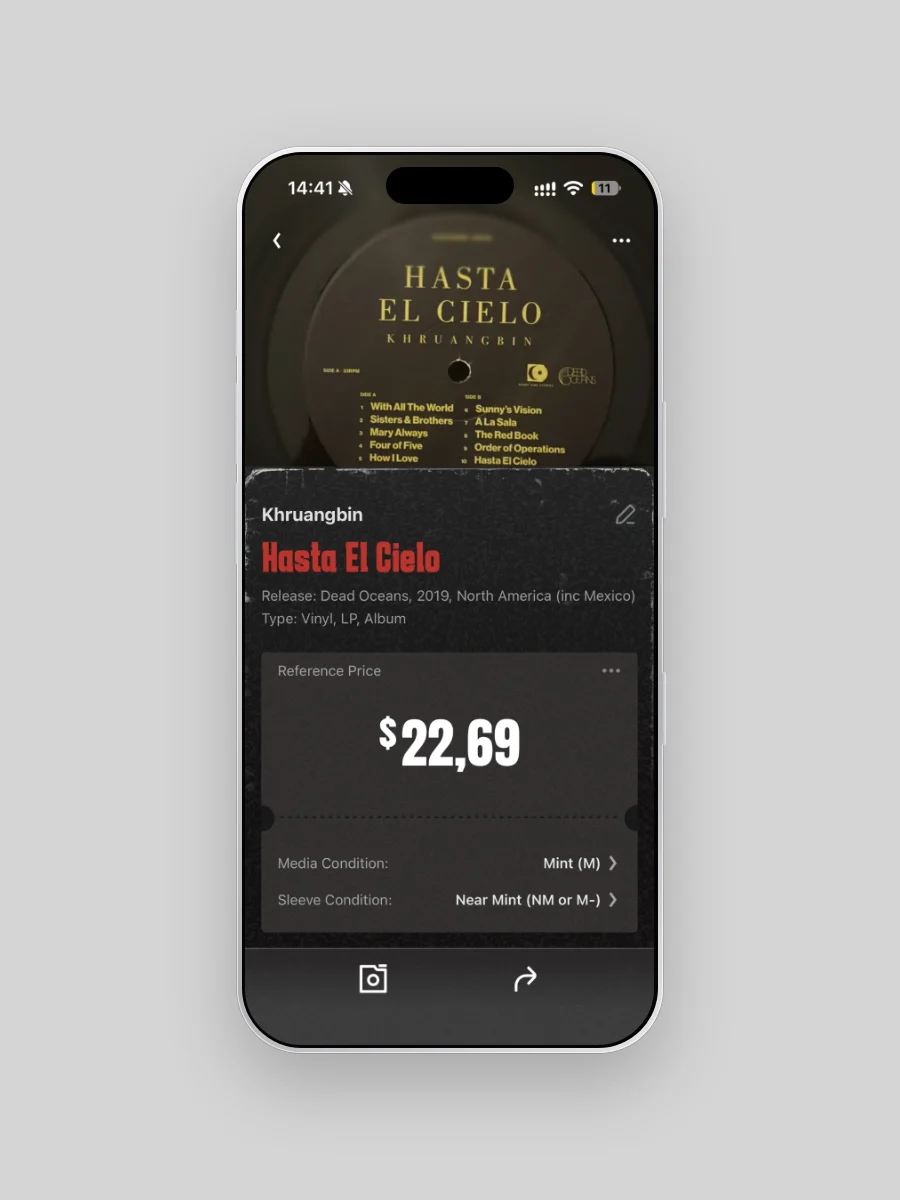
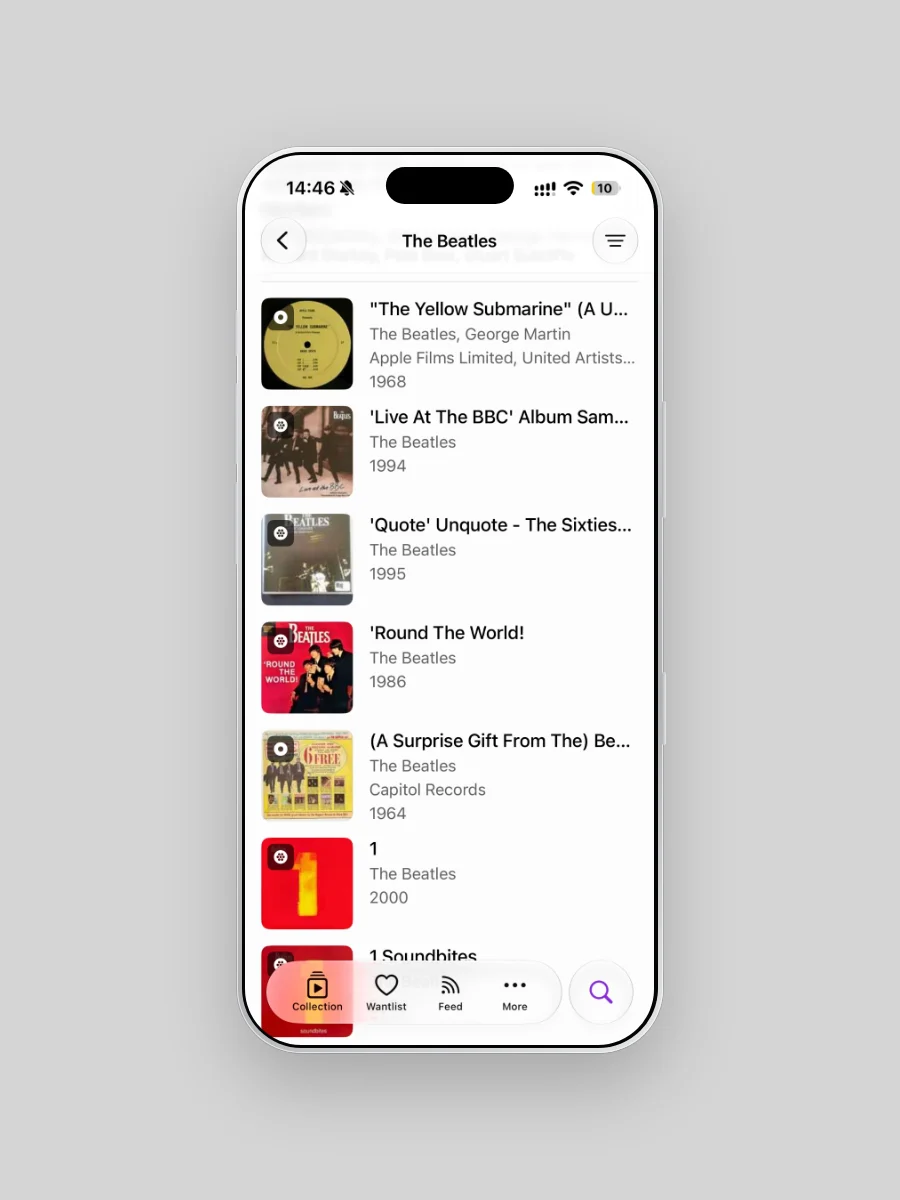
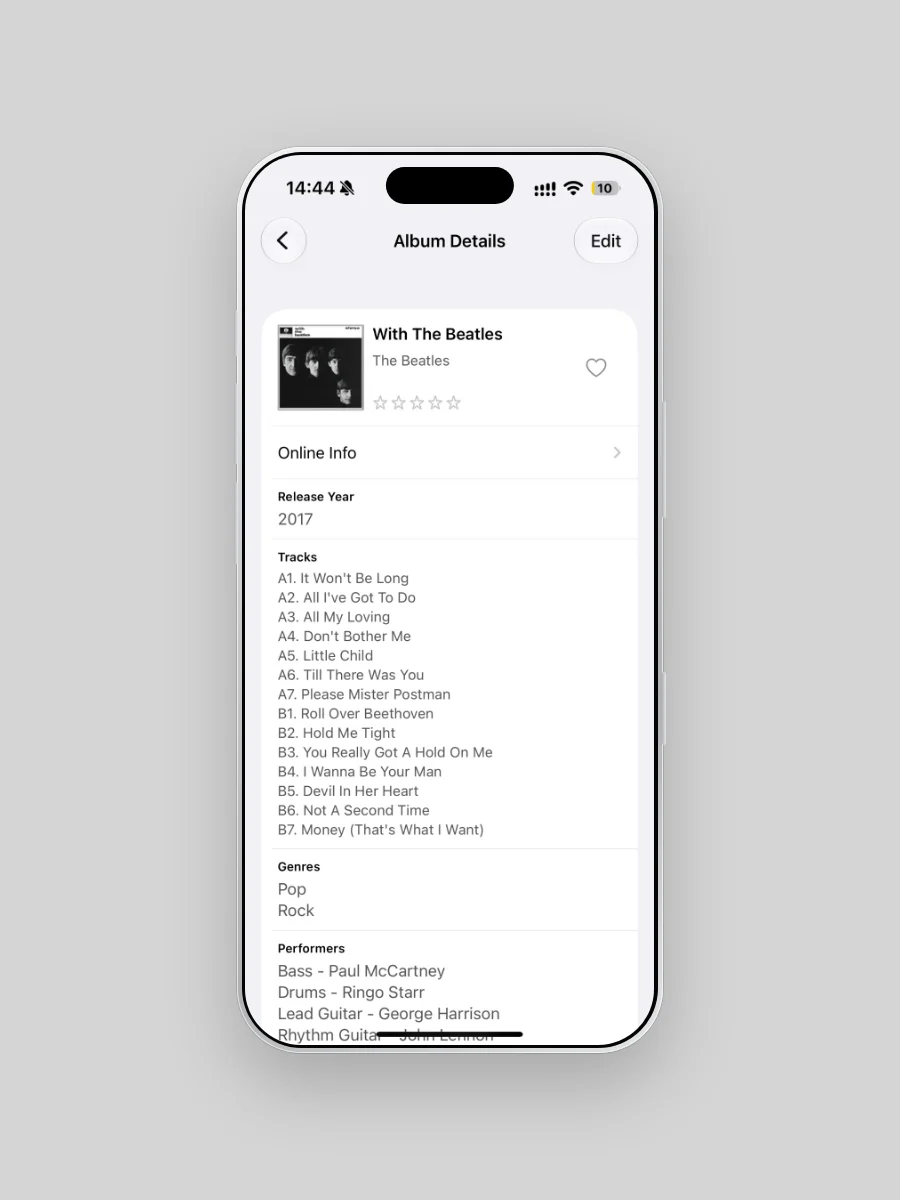
Here is the same comparison in one view. A tick means we saw it or the maker states it. A dash means we found nothing that says the app does it.
| Plastic | Discogs | VinylBox | Discographic | SnapVinyl | Groovv | Record Scanner | VinylSnap | MusicBuddy | Vinyl Record App | CLZ Music | |
|---|---|---|---|---|---|---|---|---|---|---|---|
| Artist pages | ✓︎ | ✓︎ | ✓︎ | ✓︎ | ✓︎ | – | – | – | – | ✓︎ | Your records only |
| Albums apart from live records and compilations | ✓︎ | Compilations only | – | Compilations only | – | – | – | – | – | – | – |
| Your albums marked | ✓︎ | ✓︎ | ✓︎ | ✓︎ | ✓︎ | – | – | – | – | – | Your records only |
| New releases | ✓︎ | – | – | – | – | – | – | – | – | – | – |
| Album anniversaries and reminders | ✓︎ | – | – | – | – | – | – | – | – | – | – |
| Artists you might also like | ✓︎ | – | – | – | – | – | – | – | – | – | – |
Follow an artist in Plastic
When you love a band, a list is not enough. You want their albums in order, with a clear mark on the ones you own. You want the story behind each record. You want a nudge on the day Abbey Road turns another year older, and a look at what is new.
Plastic gives you all of it. The artist page sorts the discography by type and marks your records. Album pages add the story behind the record, right under the tracklist. Album anniversaries show up on Radar, Plastic's discovery page, and Plastic can remind you on the day. New records and new reissues arrive on Radar too.
No other record collection app we tried works this way. Everything you love about your collection is in your pocket, and it is in order.
Here is the path on iPhone, with Gorillaz as the band.
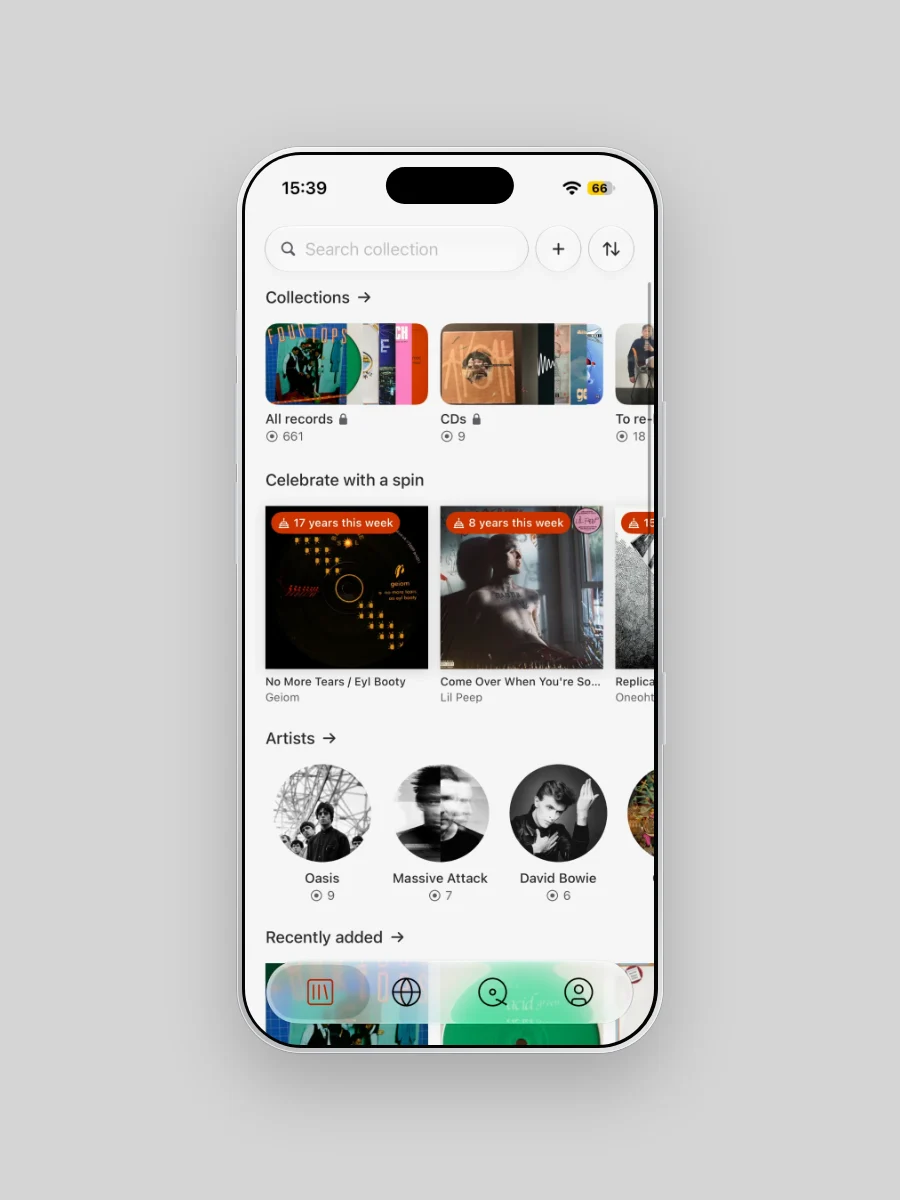
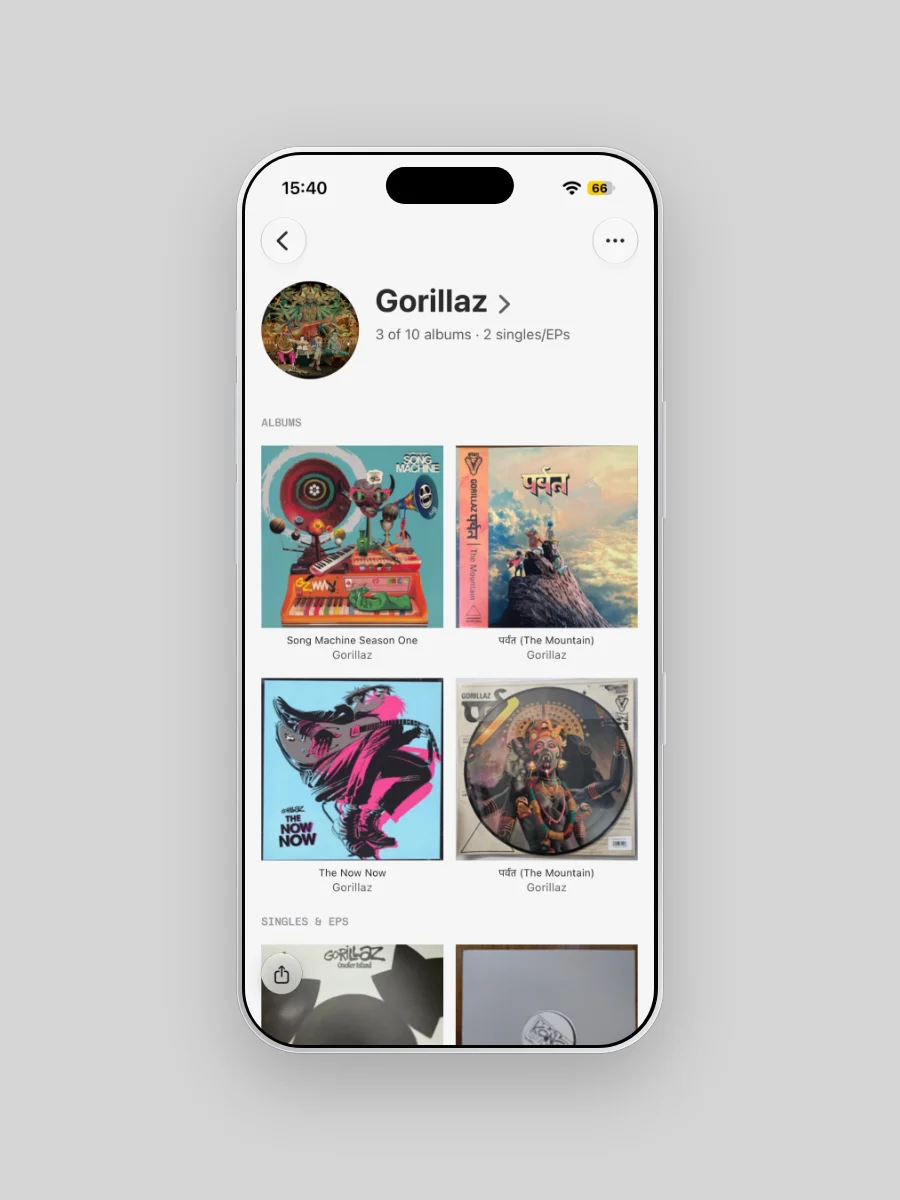
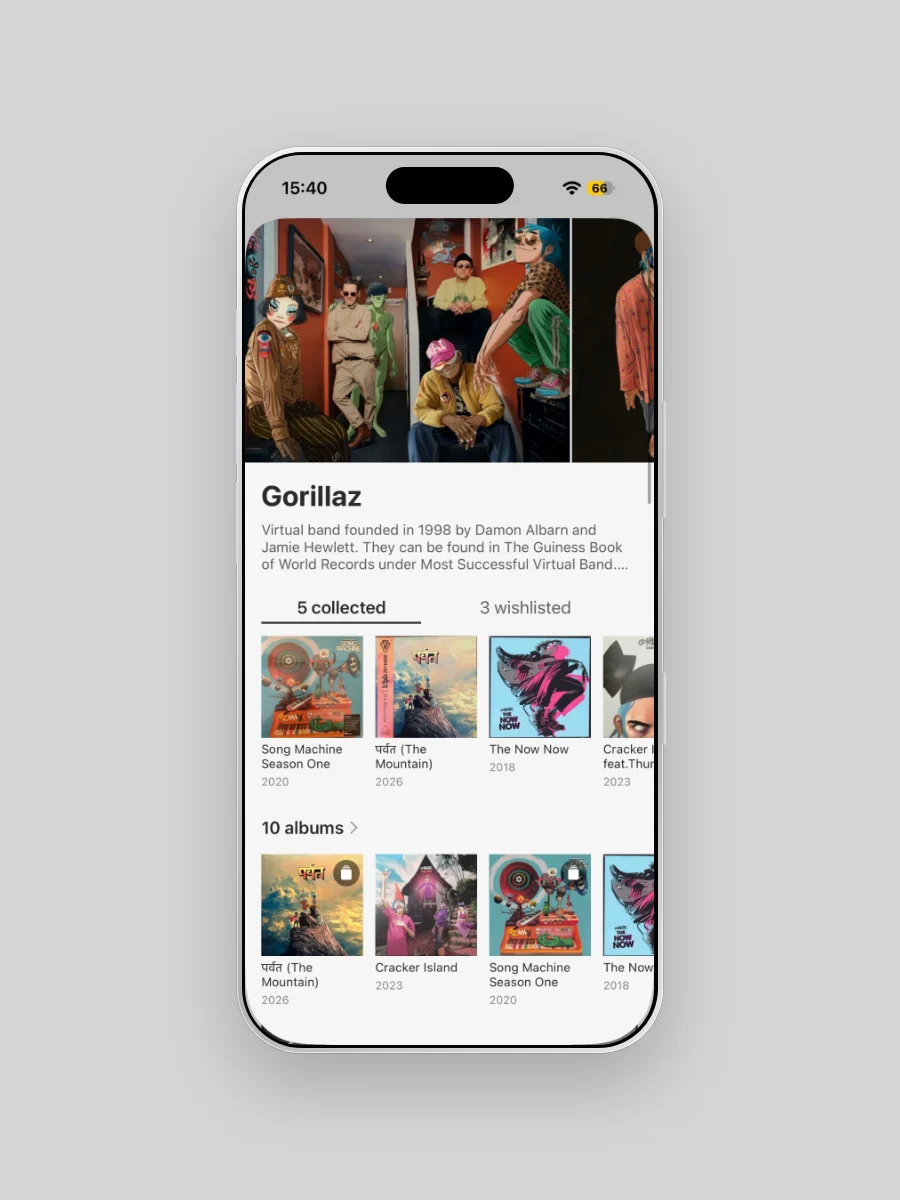
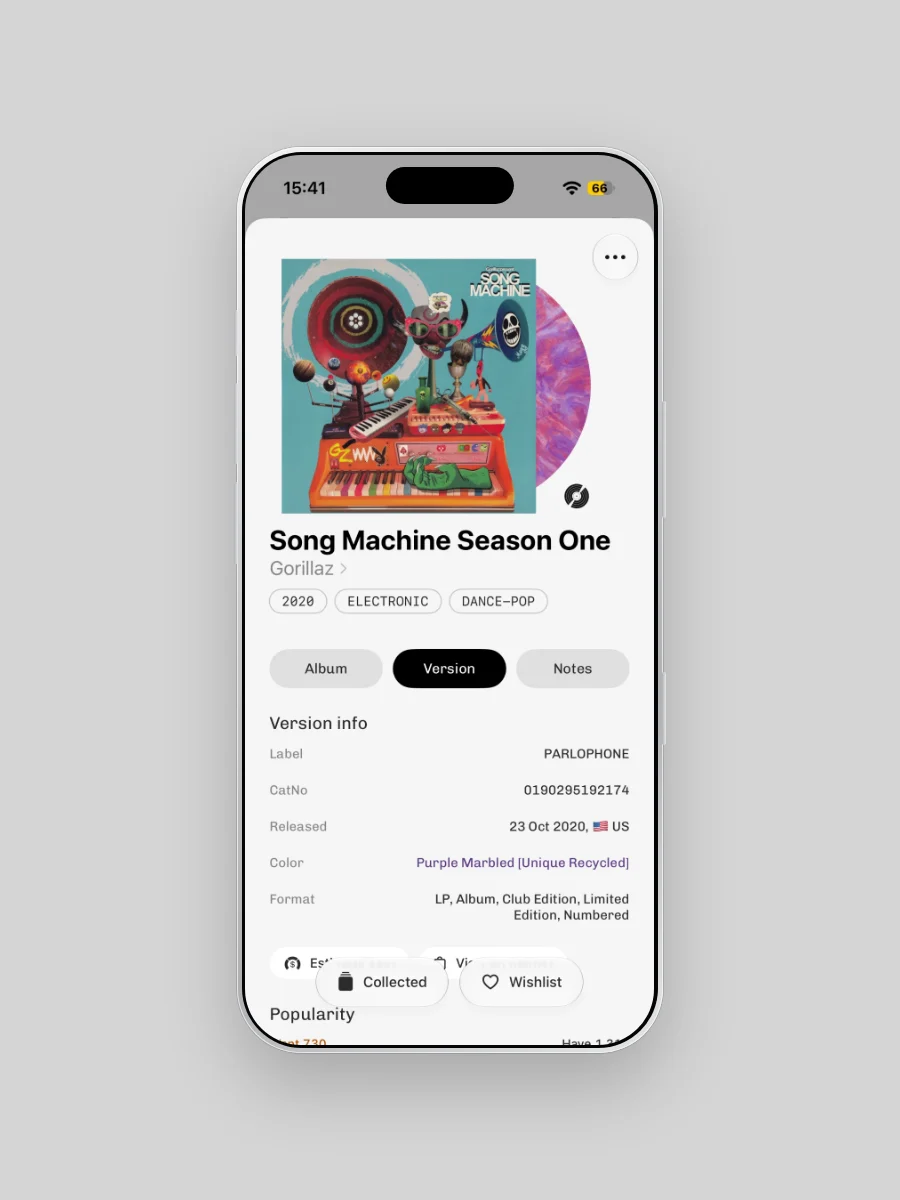
- Open your Library and tap a band in the Artists row.
- Read the line under the name: "3 of 10 albums · 2 singles/EPs". Plastic counts albums, not pressings. Own two pressings of one album, and it still counts once.
- Tap the name to open the full artist page. The top shows how many records you have collected and how many are on your wishlist.
- Scroll to the discography. Albums come first, then Singles & EPs, Live, Other releases, Compilations and Unofficial. A mark on a sleeve means the album is in your collection.
- Tap an album you miss. Add it to your wishlist, or scan the sleeve with your phone camera when you find it in a shop.
Each section shows its own count, and each count is of albums, not pressings. Records that no trusted source has typed go to Other releases, so the Albums row stays short.
You can also reach an artist from search or from any album page. Sort the rest of your shelf the same way.
Discography FAQ
Is an EP an album?
No. An EP is shorter than an album and longer than a single, usually four to six songs. The line is not fixed. The Grammys count five tracks and 15 minutes as an album.
What does LP stand for?
LP stands for long play. It first meant a 12-inch record that turns at 33⅓ rpm. Today people use it for any full-length album, on any format.
Do live albums and compilations count as albums?
Yes, both are full-length releases. A discography lists them in their own groups, apart from the studio albums.
Is a reissue a new album?
No. A reissue is a later pressing of an album that already exists. It adds a pressing, not a line in the discography.
How many songs are on a single?
Usually one to three. A vinyl single has an A-side and a B-side. Streaming services label a release of up to three tracks as a single.